Free tools / Invoice generator
Invoice generator
Fill this in and get a Letter-size PDF invoice with line items, tax and payment terms.
The form does almost nothing. It collects the fields the invoice template declares in its JSON Schema and posts them; the template computes line totals, subtotal, tax and the grand total, and lays the page out. That separation is the point: when the numbers need to change, you change the payload, and when the layout needs to change, you publish a new version of the template — and every invoice already issued keeps rendering exactly as it did.
Nothing here is a watermarked sample. It is the same endpoint your production code would call, on a 50-render trial that costs nothing and asks for nothing.
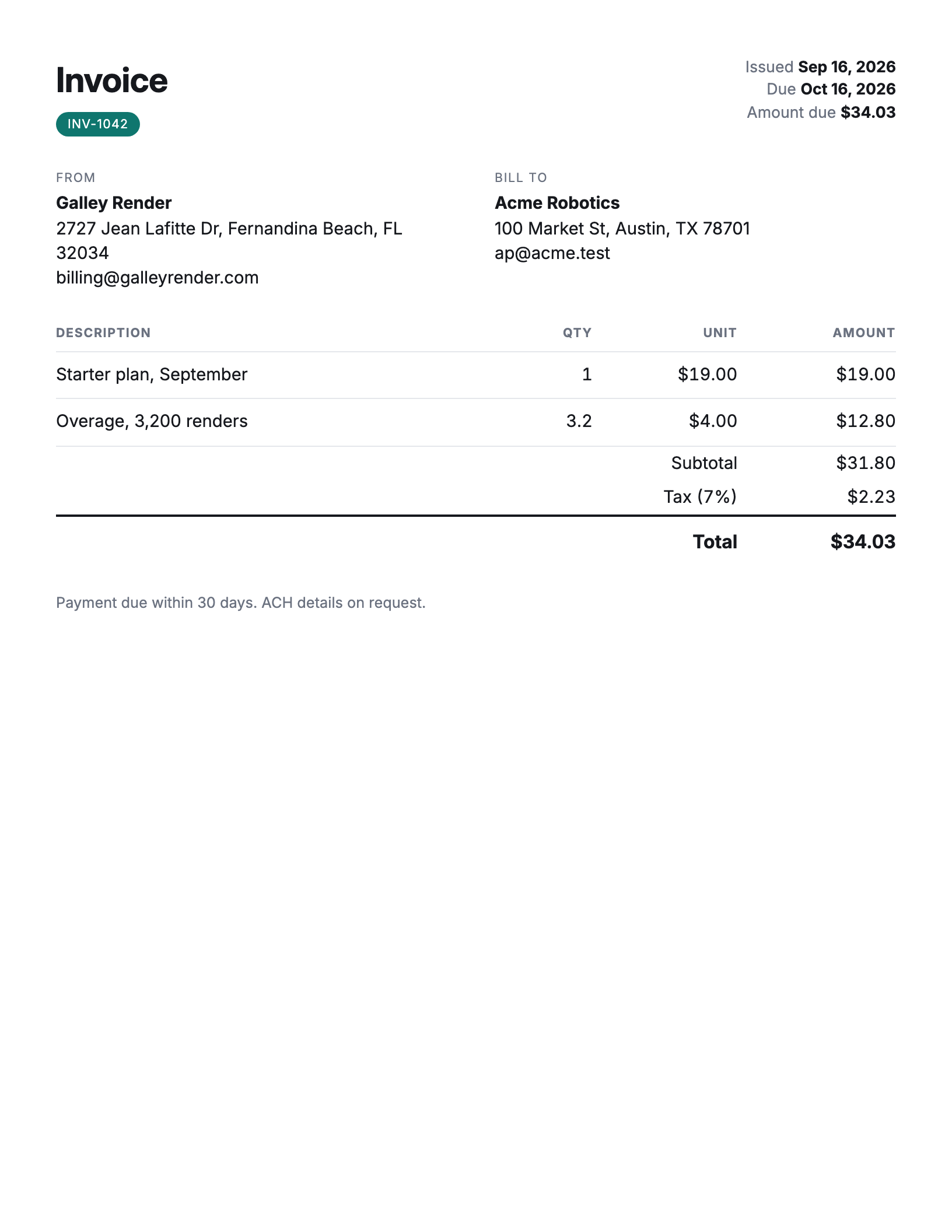
Response, verbatim
Press render invoice to see the real response.
The call this form makes
One POST. Pin invoice@1 and the layout is frozen for as long as you want it.
curl -sS https://api.galleyrender.com/v1/render \
  -H "Authorization: Bearer $GALLEY_API_KEY" \
  -H 'content-type: application/json' \
  -d '{
    "template": "invoice@1",
    "format": "pdf",
    "data": {
      "invoice_number": "INV-1042",
      "issued_on": "2026-09-16",
      "due_on": "2026-10-16",
      "currency": "USD",
      "tax_rate": 0.07,
      "seller": { "name": "Halyard Remodeling LLC" },
      "buyer":  { "name": "Dana and Marcus Reyes" },
      "line_items": [
        { "description": "Demolition and haul-away", "quantity": 1, "unit_price": 1450 }
      ]
    }
  }'
The invoice template and its schema · Do this in Node · Do this in Python